

Welcome to Indophila Collections..... my daily updated blog for collections of Indonesian Stamps, Worldwide Stamps, Covers, Postcards, First Day Covers, Maximum Cards, and acquire knowledge.... The Philatelic bridge towards global friendship and fraternity.
Showing posts with label # JOINT STAMP ISSUE. Show all posts
Showing posts with label # JOINT STAMP ISSUE. Show all posts
Sunday, 1 June 2014
South Korea


Saturday, 31 May 2014
China

Wednesday, 21 May 2014
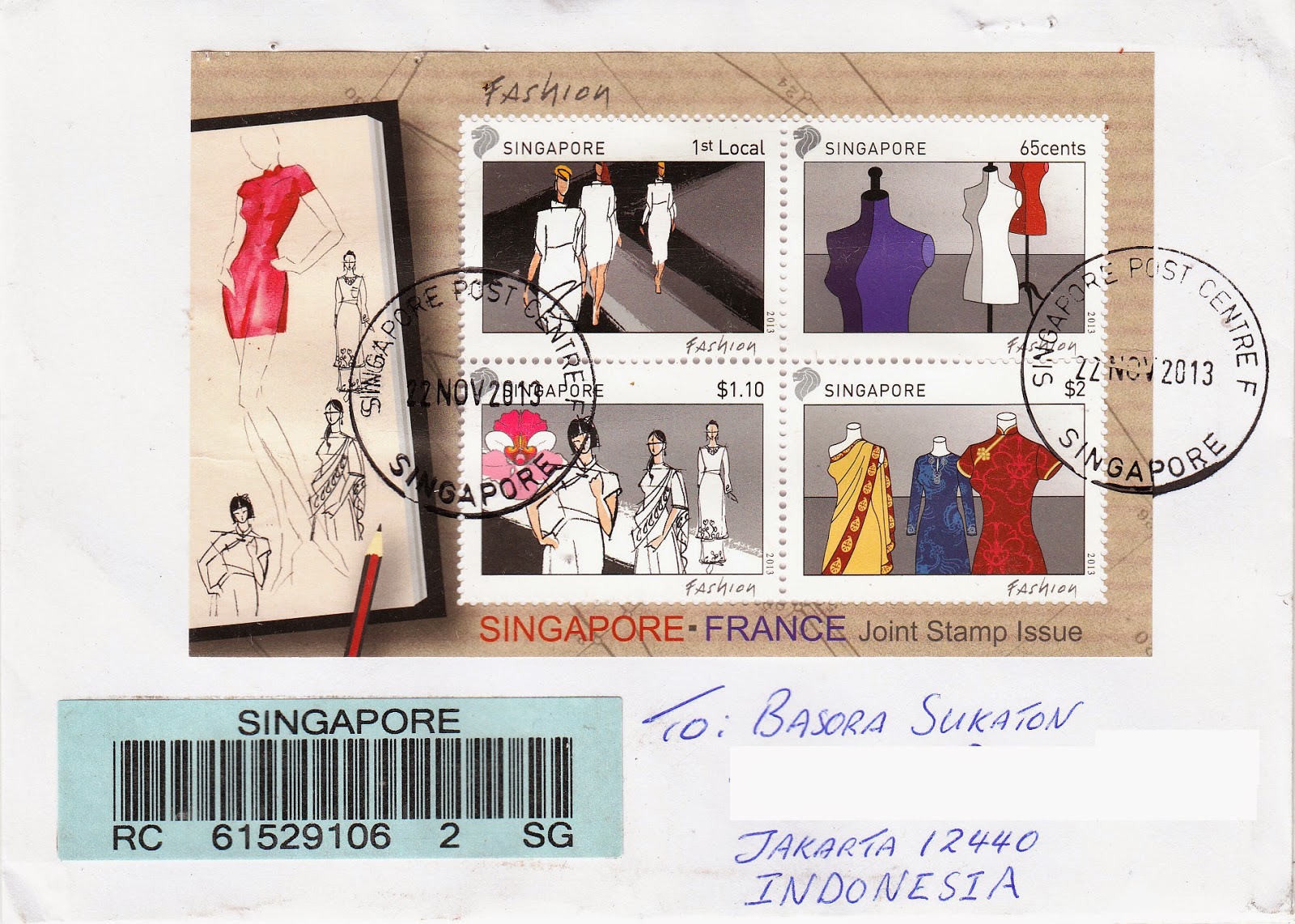
Singapore
Wednesday, 20 November 2013
China

Sunday, 17 November 2013


Saturday, 16 November 2013

Thursday, 7 November 2013



Saturday, 2 November 2013

Saturday, 26 October 2013


Tuesday, 1 October 2013


Monday, 2 September 2013


Indonesia

Kelimutu Mountain/Lake
In the local language (Flores Island), "keli" means mountain and "mutu" means boiling, shortly in can be said that "Kelimutu" means the volcano crater. What makes it different from other volcanoes is that this 1.690 m volcano has three summit crater lakes of varying colors namely Wine Red, Green and Dark Blue.
Borobudur Temple
Located in central Java, is the largest and the most glorious Buddhist monument in the World. This temple is acknowledged as a UNESCO World Heritage Site. The 42 m high structure was built on a bedrock hill in the form of three tiers, at the center top, a monumental stupa surrounded by 72 Buddha statues, decorated with 2672 relief panels and 504 Buddha statues. Built between the 8th and 9th century during the ruling of Syailendra Dynasty.
Corpse Flower (Rafflesia arnoldii)
This plant was first discovered on 20 May 1818 by Sir Thomas Stamford Raffles who was also a naturalist and Dr Joseph Arnold at the bank of Manna River, Lubuktapi, Bengkulu. This parasitic plant was named after its two discoverers. It naturally grows in the rain forest of Sumatra and Kalimantan. The flower is approximately one meter, weights up to 7 kg with the thickness of 2.5 cm.
Angklung
Originated from Indonesia, used and played by the Sundanese from West Java since the ancient time. This traditional musical instrument is made out of bamboo tubes attached loosely to a bamboo frame.
Red Arowana (Selerophages formosus)
The name "Arwana" is derived from "Nirwana" literary means heaven. For many people, Arowana is the most beautiful freshwater fish. Arowana is about 75 cm and has long life period (for about 20 years).
Indonesia

Fuji Mountain
Fuji Mountain 3.776 m is the highest mountain in Japan and also an active volcano whose last recorded eruption was in 1707 - 1708. The mountain straddles the boundary of Shizuoka and Yamanashi prefectures west of Tokyo. The Summit has been thought of as sacred since ancient times. The climate on the summit is very cold and for a couple of months of the year, the cone is covered by snow.
Pagoda of Toji
Located in North Western Kyoto, often called as the Five-Story Pagoda of Toji, which refers to its architecture. Toji (Kyo-o-Gokoku-Ji or Nation Protector) was built 796, two years after Kammu emperor removed the empire capital city from Nara to Kyoto. Since 1994 UNESCO designated Toji a World Heritage Site.
Sakura
Despite being a symbol of Japan, Cherry Blossoms or Sakura (Prunus serrulata) with its wide variety actually grows in a wider area. It is indigenous to the Himalayas, including northern India, and several Eastern Asia regions such as China and Korea. The blossoming time of Sakura has become a special moment for Japanese.
GakuBiwa
GakuBiwa is a four-string musical instrument used in traditional repertory, Gagaku. It is said that this instrument originated from Persia, crossed the Asian continent, through China and entered Japan with the introduction of Gagaku. In the middle ages Biwa was played by the Buddhist priests to tell stories and give advice. The four strings of GakuBiwa is made of silk and the plectrum is made of boxwood, thin and arround 20 cm long.
Colored Carp Fish (Cyprinus carpio)
This colorful and beautiful member of the carp family is called Koi or nishikigoi. The beauty of this fish is appraised by their most important feature, the markings and patterns. The outside world became aware of its development in 1914, when Niigata Koi were exhibited in Tokyo and some were presented to then Crown Prince Hirohito.
Saturday, 24 August 2013

Tuesday, 6 August 2013

Friday, 26 July 2013

Sunday, 23 June 2013

Subscribe to:
Posts (Atom)